
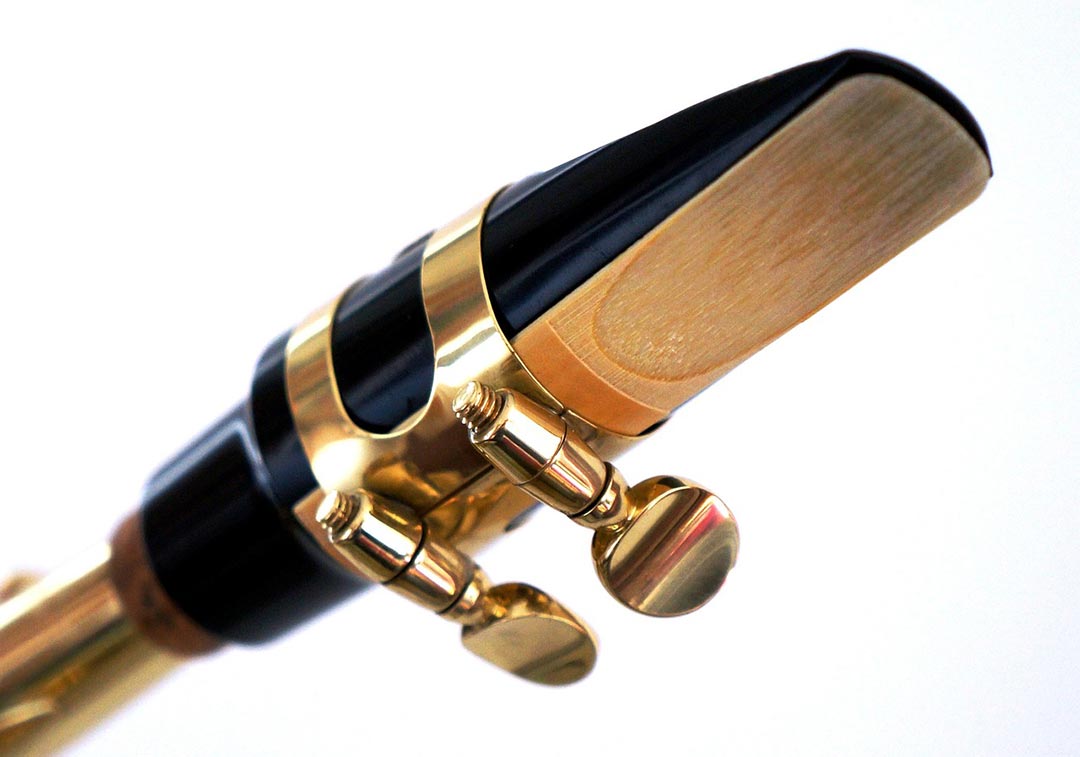
How to set up your mouthpiece on the sax
Having your mouthpiece set up correctly is incredibly important. You could be the best player in the world with the finest saxophone, the finest mouthpiece, the best reeds, and all the experience in the world. However, if your reed, mouthpiece and ligature are not set up correctly, you will not be able to get a great sound out of your saxophone. It really is as simple as that. Therefore, understanding how to set up your mouthpiece, reed, and ligature correctly is of the utmost importance. So, here are a few things that we need to check before we start playing.
The reed must be in good condition, meaning it is not split, chipped, mouldy, or dirty in any way, and it is placed correctly on the mouthpiece. This means that it should not be at an odd angle but should be in line with the tip of the mouthpiece and also in line at the base of the mouthpiece. The distance between the tip of the reed and the tip of the mouthpiece should be about a hair's breadth. This will be a fraction of a millimeter down from the tip of the reed. It is also important that the reed has some moisture in it and is not completely dry. There are several ways to add moisture to the reed, including soaking it in a cup of water for a few minutes before playing. This may not be convenient if you are playing at a gig, so what a professional might do is to wet the reed in their mouth for a few seconds and push saliva onto the reed with their tongue.
If the reed is completely dry it will not play properly.
The ligature should also be placed correctly. Ligatures come in many shapes, sizes, and designs, which can be something of a minefield if you're not used to the different designs that ligatures come in. There are neoprene ligatures, metal ligatures, ligatures that have screws designed to be on the opposite sides to the reed, but the most common type of ligature is a metal ligature with two screws, and these two screws should be on the same side as the reed is on the mouthpiece, at the heel of the reed. The ligature should not be overly tight. This is a very common mistake that beginners seem to make, and I can see why. The reason is that we are told that if you see a screw, the screw should be tightened very tight. It's kind of obvious, but in this case, we absolutely do not want the ligature screws to be too tight. If they are, they can interfere with the reed's ability to resonate. The correct tightness is just finger tight. As soon as we feel some resistance, we should stop tightening.
The position of the ligature is also very significant. It mustn't be too high on the reed or too low down, and it absolutely mustn't be above the heel of the reed in a way that could interfere with the upper shaved section of the reed, which vibrates.
This all makes it sound as if it's almost an impossible task to set up your mouthpiece, reed, and ligature correctly. However, it's not impossible, and it is something of a knack, but like everything to do with the saxophone, it can take some practice until you get it right. It is absolutely worth taking the time before you start playing the saxophone to check that your mouthpiece, reed, and ligature are set up correctly because if they aren't, you're going to have a very dissatisfactory practice time!
Have a look at this video which details exactly how to set up your mouthpiece, reed and ligature properly: https://youtu.be/Gr07oJZaPms
Lynden



0 Comments